Muda dibaen na tu gas gas, jari jari on ma na lima....... (Eng: If you go to a grassy plantation, use your five fingers) : W Iskandar
http://mandailingestatecoffee.com/
Coffee is one of the most popular drinks in the world. What on earth is kopi luwak? Quite simply Kopi means coffe and Luwak is the name for the Civet cat. So Kopi Luwak translates to coffee cat – or coffee from the Civet cat. Nice ring to a coffeee..... Kopi Luwak coffee is collected from coffee berry beans which have been digested by the Asian Palm civet in Sumatra. The Asian civet eats the ripest berries for their fleshy pulp which allows the proteolytic enzymes in its stomach to percolate into the beans. This process breaks down the proteins in the green beans creating a unique exotic flavor. Once the Civet expels the coffee beans through its feces our local farmers from Bandar Lampung in Sumatra collect it for processing. Each step is meticulously performed to ensure cleanliness and quality before roasting.
As you have no doubt surmised, the unique taste and aroma of these coffees are routinely attributed to the fact that the beans have been chemically modified by the acids and enzymes in the animal's digestive tract before they're excreted and harvested. Less frequently observed but more to the point, in my opinion, is a characteristic of all members of the civet family which surely influences the fragrance of the beans: "anal scent glands that secrete a fluid with a musky odor" (American Heritage Dictionary).
10 Facts About Kopi Luwak You Should Know! 1. Just like other type coffee, civet coffee / kopi luwak has validated on freshness. The sooner you enjoy kopi luwak., the fresher coffee you get. More less it takes 2 months (for ground coffee) or 4 months (roasted bean) you still have the freshness. 2. Real kopi luwak lasted rich, full body, more like syrup, and aroma is very strong. 3. Civet coffee/kopi luwak defines on two kind of natural process; wild and farmed. Wild kopi luwak is better than farmed, but nowadays it’s too good to be true since the forest area become rare everyday. Yet, it’s uncontrolled by hygiene and decay process. 4. Civet coffee comes from various origin. Philipine, Vietnam, Indonesia. Oprah Winfrey Show defined Sumatra kopi luwak is the best ever. 5. Recommended roasting kopi luwak /civet coffee is a not too high or too low roasting so the originality of kopi luwak taste is still there. The higher roast U take, the bolder intense taste U get & eliminate more variant originality of the coffee.You can put cream to make your civet coffee more You! Just experience your own civet coffee. 6. Arabica type kopiluwak civet coffee has more variant taste & acidity than Robusta. It’s stronger as well. Robusta is milder. Western adores more Arabica kopiluwak while Asian prefer Robusta. 7. Even kopiluwak civet coffee comes out fr poop, the bacterial contents lower than other coffee. It’s caused by fermentation process that eliminate protein & bacterium which change the aroma & taste more awesome. 8. The hype of kopiluwak civet coffee hit ppl in d’world.South Korea ppl consider kopiluwak as prestige coffee with $45/cup. 9. Despite using classic drip or french press coffee tool, U can boil kopiluwak civet coffee. 10. Civet kopiluwak coffee is safe for ulcer patients. Posted by A. Wibisono
Mandailing traditional architecture as a product of high culture and enriched by symbols like the other traditional building in Indonesia. Product of Mandailing traditional architecture consist of Bagas Godang and Sopo Godang which are equipped with Sopo Eme or Hopuk. These building spread in Penyabungan District, Kotanopan and Muara Sipongi. These traditional building are the inheritance of kingdoms from Lubis and Nasution clan in Mandailing.
Bagas Godang is also called village bagas and this is house for the huta’s king or tunggane ni huta or King Panusunan as the leader, huta’s regulator, upholder and as the village guardian. Bagas Godang as a main village building in a huta and a clan symbolizes bono bulu which means a custom unity with namoranotoras (honorable leaders), kahanggi (family in same clan), anak boru (family for son-or daughter-in-law), datu, si baso, ulu baling, artist and king Pamusuk as king of the village.
Bagas Godang also has a function as a place for gathering or meeting and as a place of protection for each member of the society who has disturbance from other huta. Closed by Bagas Godang, a Sopo Godang which is used as museum for art instruments like gordang sambilan. Ogung is a place for discussing and conference, place to decide customary, place for visitors and tortoar as stage for art performance.
Bagas Godang and Sopo Godang are also equipped with Sopo Eme or Hopuk whose their function as rice barn. Sopo Eme and hopuk have a meaning of social prosperity and each member of society who doesn’t have enough food, they could ask help to the king.
In front of Bagas Godang, there is wide flat ground as the yard of Bagas Godang or Alaman Bolak Selangseutang. This yard is a place for traditional ceremony and protection from outside disturbance. Every member who takes cover at Alaman Bolak could not be disturbed, hurted, or hit because that person has been under protection of the king. The King will bring the justice by discussing with the honorable leaders. Today, this yard also becomes a place for art performance gordang sambilan, monortor, martial art training and other Islamic occasions.
The other facility in a huta is Pancur Paridian or tapian mandi. A hut in rice field called Sopo Saba, and in garden called Sopo Ladang. The king graves are protected by a building called Bale.
By : Cut Nuraini : Fakultas Teknik Sipil & Perencanaan Jurusan Teknik Arsitektur dan Jurusan Perencanaan Wilayah dan Kota, Institut Teknologi Medan (ITM).
For centuries the Mandailings, an ethnic group from the island of Sumatra, have travelled across the Straits of Malacca to seek their fortune in Malaysia. THE Straits of Malacca has never posed a barrier to human movement from Sumatra to Malaysia and vice versa. The Mandailings have been arriving in Pai Kolang, as they call Klang in Selangor, for centuries to seek their fortune and mine tin before heading back to their ancestral villages. The Mandailings in Sumatra still remember their Ompu Kolang, forefathers from Klang, today.
This picture is of Datuk Setia Raja of Batu Gajah (seated on the right of the empty chair) and his Mandailing clansmen. The `empty` seat is occupied by a rubber sheet, commemorating the fact that the Mandailings were amongst the first non-Europeans to cultivate rubber in the Kinta Valley, Perak.
In fact, the mass migration of Mandailings to Klang and other parts of Peninsular Malaysia preceded any substantial migration of Mandailings to the east coast of their own island. The latter movement only occurred in the 19th century during and after the Padri War.The early Mandailing mining areas were clustered around the two Kinta tributaries, Sungai Johan and Sungai Raya. The Mandailing miners were involved in mining, smelting and trading in tin in the Kinta Valley.De la Croix's scientific report on the potential of the Kinta valley soon attracted European mining intrerests. Raja Bilah as Penghulu of Papan was the one who guided de la Croix on the tour of Papan valley, and it was he who first showed de la Croix the mining deposits at Lahat, near Papan. The French eventually opened the Lahat French Tin Mines in 1882, which became the first European company to break the Chinese monopoly on tin production. Raja Bilah also showed a mining site in Papan to J.H. Hampton of the Shanghai Tin Mines, which was set up by a few enterprising merchants from Shanghai.
A PERMANENT HOME
When Raja Bilah first moved to Papan with his family at the beginning of 1879, he built a "rest-house" (rumah rehat) to stay in. He finally chose a hillock as the site of his permanent home when after three years of sinking holes to prospect for tin in that place "not even a coconut shell of tin ore was found." It is believed that he built his bagas godang (raja's dwelling) in 1882.
The house was probably constructed by Raja Bilah's Mandailing followers and it still stands in Papan today. It is erected on simple rectangular plan, and faces east. Built of chengal and other timbers, unplaned logs were used as beams. Simple cross latices served as vents above the windows and doors. The hipped roof, now of corrugated metal, could originally have been made from attap or some other natural material.
The design hardly reflected the architecture of Raja Bilah's homeland in Tapanuli where the chief's house and other notable buildings would have sweeping roofs with pointed ends, made of ijok. Whether or not the house has any construction details betraying the contribution of Mandailing builders is a matter for future study.
One feature, however, is conspiciously Mandailing in origin, though it may have been adapted in form. The house is raised high on brick piers, part of it over a reservoir called a tobat, now no longer in use. Fresh running water used to be conveyed from a nearby stream by means of bamboo ducts and fed to the pond. The pond water itself was used for ablution.
On the north side, a bath house was built over a platform (pelantar) with open slats over the pond. A separate area next to the pond was used for washing and this was drained by a open ditch (parit). The pond itself was filled with water lilies and fish, in particular a kind of gold fish (ikan emas), which the Mandailings serve on feast days such as the Eid-ul-fitri, Eid-ul-Adha, weddings and installations. The community would get together to clean out the tobat once a year.
In 1884, Papan was linked to the towns of Ipoh, Lahat, Batu Gajah and Kota Baharu in the Kinta Valley by means of a postal system consisting of "dak" service - relays of runners and horsemen who carried the mail - linking these towns to the outside world.
THE PAPAN MOSQUE
In 1888, the Papan mosque was completed and the first Friday prayers were held. Raja Bilah had done his duty as the leader of the Muslim community by providing the land and building the mosque. Mandailing carpenters had erected the mosque in the character of the mosques in Tapanuli. It was a large timber hall raised on piles, with a full bay for a mihrab, and a double-tier hipped roof capped by a finial. Prayers were announced by beating the drum (tabuk) followed by the Bilal calling out the azan (call to prayer).
For many years, the Masjid Papan was the only mosque in the vicinity of Papan and Muslims came from miles around to do the daily and Friday prayers. The Papan Mosque still stands today. At the author's request, the Architecture Department, University Technology Malaysia (UTM), did a measure drawing of the mosque in 1996. In 1999, the National Museum turned the mosque into a training restoration exercise for its staff.
THE RUMAH BESAR
After Raja Bilah had attained some measure of prosperity, his concern now was to ensure the long-term future of his people in Malaya. As the founder of the Sumatran community in Papan, he had not only built a mosque for his people but also allocated a piece of land on an adjacent hillock called Changkat for Muslim burial ground.
Now the next thing that had to be accomplished was to build the customary seat for the Raja, a sopo godang, a "council house", where his family would play out its role as the patron of the community. The Rumah Besar would be used for the conference of elders, for charity feasts given to Muslims, for weddings and other receptions. It also impressed the "orang putih" and raised the standing of the Mandailing community in the eyes of the other peoples.
Going by Raja Bilah's will the Rumah Besar and its contents was a family endowment or private waqf.. It is a tradition among the Mandailing chiefs, and men and women of standing to leave an ancestral home for the clan. It would serve to bring the children and descendants together during ceremonial occasions such as marriages and Muslim feasts.
The council house was to be located on the hillock right next to Raja Bilah's timber house. As Penghulu, Raja Bilah enjoyed some privileges. Apart from salaries and commissions, he would also have been given a site for his house and garden free of land rent. He may have applied for an outright grant for his house-site before building the Rumah Besar.
Before work commenced, supplications (du'a) were made. An auspicious day was chosen to start building, and a fistful of soil from the Mandailing homeland was scattered at the foundation of the mansion. Constructed mainly by Chinese craftsmen, the Mandailings chipped in in gotong-royong fashion, helping their chief put up the house. Elephants may have been used to raise the large timber beams.
The Rumah Besar Raja Bilah was a double-storey house with a tiled roof, the lower floor of brick and the upper floor of chengal timber. It had a large hall downstairs and another one upstairs which could accommodate large gatherings of people.
Its interior shows that it is different from the mansions of the rich Malay aristocracy and Chinese miners of Kinta. It has a large hall with eight-sided columns and was used as a meeting hall for all the Mandailings in Perak, and from this evidence we know that it was functionally a sopo godang. The use of eight-sided columns symbolises a community hall.
A Penghulu's office was built into the buttress wall along the side of the hillock, and this was thereafter called "Balai Penghulu". Stucccoed over the gateway leading up the side of the hillock to the mansion was the date of completion - 1896. The year 1896 was also significant to the district because the Kinta Valley Railway connecting Ipoh to the port of Telok Anson had begun operation.
The descendants of Raja Bilah have always called the council hall, Rumah Besar, but in more recent times it has come to be popularly known as "Istana Raja Bilah" (Raja Bilah's Palace) probably out of the mistaken notion that Raja Bilah was a Malay Raja and therefore his house would be an Istana.
THE RUMAH BESAR
The Rumah Besar is being taken care by the ancestors of Raja Billah namely
Puan Hafizah Kamaruddin (Bernama) Puan Fatemah Adenan (Royal Ipoh club) Abdurr Razzaq Lubis (Writer) and Sma Lubis
The interior of the Rumah Besar
THE PAPAN MOSQUE
Last December I had the opportunity to visit the Rumah Besar and we had a tea party to Commemorate it.
The Mandailing people in northwest island of Sumatra are a clan-based society with an indigenous tradition of representative and consultative governance. They are well known for their ancient tree-bark books, their contribution to modern Malaysian and Indonesian literature as well as their ritualistic music of the Nine Great Drums. They practice an indigenized brand of Islam where customs and customary usage is considered close to religion. Their habitat ranges from well-irrigated highlands with volcanoes to marshy lowlands.
me garb in the traditional Mandailing Ulos
The ulos is normally worn draped over the shoulder or shoulders, or in weddings to ceremonially bind the bride and groom together. Ulos are traditionally hand woven and in the case of higher-quality examples are significant family heirlooms, to be worn at important events, such as funerals and weddings.
Nine Great Drums (Gordang Sambilan)
Their tropical rainforest is rich in biodiversity with, amongst others, Sumatran tigers, rhinoceros, serows and Rafflesia flowers. Their productive economy is based on paddy, rubber, palm sugar, cinnamon, coffee and gold mining. ‘Mandheling Coffee’ is famous amongst coffee connoisseurs today. There are over 300,000 Mandailings in the homeland in Sumatra, and with about equal numbers throughout the rest of Indonesia and an estimated 200,000 or so, in Malaysia. The Mandailing homeland is today called the regency of Mandailing-Natal (Madina), in the province of North Sumatra, Indonesia.
The environmental worldview of the Mandailing people is embedded in its language, folklore and cultural heritage. The great epic of the Mandailing people, speak of the elements, the sky and the earth. The recitation of the epic invokes the earth, water and habitat guardian. The story-teller employs five different types of languages to transmit the oral tradition, including that of the camphor-gatherers as well as proverbs and maxims.
The epic begins with, “Once upon a time in the primordial past, the plant kingdom flourished and its flowers and fruits were abundant....” The symbolism used in the epic which forms the essence of Mandailing ethics and governance point to a way of life that is intimately bound to the forest and natural habitat.
This close connection to the habitat that they lived in is also reflected in the place names, which is named after rivers, trees, mountains and such. Names of soil types also reflect an intimate relationship with ‘nature’. For example, a fertile land is called green land.
Mandailing tradition defined the classical role of the Mandailing leader in naturalistic terms. The Mandailing nobleman is likened to the baringin tree, a place of shelter; its spreading roots a place of protection, its canopy a cover for the head. The nobleman’s acute sense of hearing is likened to the rhinoceros.
Traditional Mandailing society has a few key concepts on division of land resources, territoriality and jurisdiction, and the management of resources. Central to these are the notion of a politically unified territory held together by customary law that secures territorial integrity as well as control over resources.
This set up has a defined territory, citizen and jurisdiction governed by a council of nobles and elders representing clans, nobility, religious functionaries headed by a chief. The strong connection of a Mandailing to his or her territoriality is testified by the fact that when two Mandailings meet, they first and foremost ask which territoriality the other is from.
Elements representing the animal kingdom feature prominently in the houses of the nobles and elders called ‘house with horns’ or ‘house of ornaments’. The horns symbolize the sacrificial buffalo, sacrificed during ceremonial and ritualistic occasions.
In a typical Mandailing settlement, the chief's dwelling and the council hall are far more important and significant than the mosque. These two customary buildings reflect the status of the settlement as an autonomous entity.
In the chief’s dwelling, the sacred Nine Great Drums are placed. It is played at customary ceremonies such as weddings and installations, and ceremonies to mark the death of the nobleman. The death of a tiger, described as the king of the forest, is similarly commemorated.
In Mandailing society, the management of the environment is tied to the origin of clans and settlement, social structure, system of land tenure, governance and sense of territory. Mandailing society in the past and up to this day is a rural, agrarian and pastoral society. The main agricultural activity is paddy planting. Ownership of a plot of paddy land is critical to Mandailing social life as it defines ones’ standing and status in society.
In the Mandailing perspective, a territorial unit is only complete when it constitutes land and water. The land and water in a settlement is communally owned and its usage has to conform to the customs as well as the sanction of the council of nobles and elders.
The water systems in Upper Mandailing are a feat of traditional water management and engineering. An extensive irrigation system provides for religious, domestic, agricultural and other uses. As such, settlements are strung all along the streams and river banks, traversed by path and canals leading to the paddy fields. One can hear the water flowing 24 hours a day in a typical Mandailing settlement.
Mandailing settlements are always located near a spring, stream or a river, which is used for domestic, agriculture, fisheries and religious/ritualistic purposes. Each territorial unit has its own protected forest area, where agriculture, hunting and harvesting of forest products are prohibited. These are usually are watershed areas, believed to be where the spirits lived.
Inspired by the traditional concept of protected areas, local communities in the Mandailing homeland have been overseeing the implementation of the river protection program. The practice prohibits the harvesting of fisheries resources close to human settlements for a stipulated period. Implemented in 70 settlements, Mandailing has the largest river protection scheme in the province of North Sumatra.
The income derived the harvesting of river resources is used to pay for the development of social facilities such as schools, roads and mosques, providing educational scholarships and administrative salaries, charity towards orphans, poor and invalids, etc. The income generated by this community-based ecological resource management program benefits the community directly.
Both mother and child 'village republics' are autonomous in implementing their system of governance. The general rule is that the chief of the Nasution clan rules settlements in Lower Mandailing whilst the nobleman of the Lubis clan rules settlements in Upper Mandailing, but there are exceptions.
The Mandailing nobleman governs in council, in that, he acts in concert with his counsels. The nobles and elders jointly carry out their duties and obligations of governance and customary laws, which covers not only social and ceremonial matters such as marriage but also matters of local governance such as division of new paddy lands, rights of water and pastoral land, and so forth.
Although the territorial units were terminated by the Japanese imperial army in the 1940s, which meant that the nobles and elders lost their territoriality and powers to function effectively in Mandailing society, it did not wipe them out of existence and to this day, the nobles and elders still play a recognized role as arbiters of the customs although their authority is circumscribed.
Abdur-Razzaq Lubis, Independent Scholar/Activist (Penang Island, West Malaysia)
Animals eat other animals to survive; that’s nature. It’s cruel, but it’s necessary to the continued balance of the animal kingdom. However, some animals seemingly just to prove that nature will always find a way to freak us out, have a tendency to eat their prey whole and fully aware that it is about to spend the rest of its life staring at a wet wall of muscle. Here are the top ten animals that do exactly that, starting with …
10. Snakes
Snakes eating animals whole is an image so cliché and uninspired that just writing it down here resulted in us having to pay Disney royalties. However, the limit of what a snake is able to eat seems to have no real upper limit save for how stupid the snake is willing to look (see above image). Since snakes increase in size along with their prey, this has led to stories about snakes eating everything from goats to freaking alligators, the latter of which resulted in the snake exploding because the alligator clawed its way out of the snake’s stomach. Which if we’re honest, only makes us respect alligators more and fear snakes less. But by far, one of the more insane stories involves a snake that ate a sheep. You may be thinking why is this more insane than an alligator punching its way out of a 13-foot long snake’s gut; well, the sheep was pregnant. Meaning at one point in history, a snake ate a creature with another creature growing inside of it. Russian dolls can suck it; nature has them topped and then some.
9. Frogs
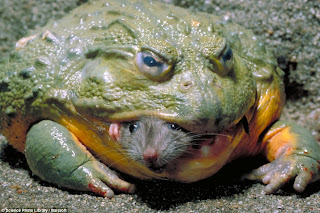
Frogs eating things isn’t really that much of a shocker, since they’re literally known for eating things. Every cartoon adaptation of frogs shows them eating flies like rice. That’s thinking small scale though. Not all frogs are tiny little croaking balls of noise; some of them are freaking huge. And when an animal is huge, it has a diet to match. For example, African bull frogs, which can reach almost a foot long, routinely eat mice. Now we know this is just part of the circle of life, but how many of you reading this honestly expected you’d learn that frogs in the wild will sometimes straight up eat a mouse like it was a piece of pasta?
8. Pelicans
Pelicans are awesome; they’re like someone combined a handbag with a seagull. How can you look at one and not remember that one saved Nemo? Well, for a start, you could watch this video of one eating a pigeon, and realize that had Nemo not found a friendly pelican to ride with, he probably would’ve been next. The worst part is, it wasn’t a freak occurrence; after that video went viral, dozens of people stepped forward to say that they too had seen pelicans mouthnap other birds. These are birds remember, as are pelicans, so they’re roughly the same species. This matters not one iota to the pelican, who will gladly and readily swallow a terrified pigeon as it struggles for life in the belly of a creature who looks like it’s always just about to open its gaping maw and let people see what Hell looks like. But that’s not the only thing birds have to worry about.
7. Monkfish
Monkfish, despite being tasty as all Hell, are a combination of a toilet lid and Freddy Kruger’s early make-up tests. They look like someone ran a nightmare over in a tank, and drew a face on it. The fish is well-known for up and eating other fish as it waits patiently beneath a thin layer of sand. One second they’re swimming along enjoying being a fish, and the next they’re YouTube fodder. Sucks to be them. However, according to this source, the fish have also been known to eat sea birds. Basically, imagine the Jaws poster, only instead of a woman swimming it was a bird, and instead of a shark it was a soul-sucking monstrosity.
6. Turtles
Turtles are creatures that get nothing but good press. They’re cute, they’re dopey, they make great ninjas, and they have a mouth that looks like a Predator’s vagina. Well, that food hole is actually quite terrifying, as it’s specifically designed to trap creatures inside it. However, the turtle once again scores brownie points simply because its favorite food is jellyfish, and those things suck. It’s noted that turtles pretty much vacuum up jellyfish whole, eating hundreds of them per day. Sure, compared to the turtle itself, the jellyfish are tiny, but you have to realize that the turtle is not only sustaining itself on a diet of creatures we humans literally have to piss ourselves to avoid being hurt by, but they do it like they’re chomping down on a box of Chicken McNuggets. Man, turtles are cool.
5. Sharks (Just Not The One You’d Think)
When we saw the word “sharks” up there, even we thought we were going to spend a hundred words talking about great whites. But no; despite his name, Jaws mostly chews his food. However, there is a member of the shark family that eats things whole, and seemingly just to prove that nature hates us, the thing it eats is OTHER SHARKS!! We can’t really imagine the surprise this National Geographic photographer felt when he snapped a photo of a wobbegong eating another shark. Wobbegong? We’re sorry, but that sounds like an 80-year-old trying to describe the sound dubstep makes. It is now way suits a creature that looks like someone glued sea weed to a failed Pokemon design. Oh wait, it’s Australian? Now it makes sense. Leave it to those crafty Aussies to give a shark that eats other sharks whole a stupid name, just so we wouldn’t be scared of it. Nice try, Australia.
4. Owls
Owls. Just … owls, man. The worst thing anyone ever did in the history of humanity was putting Hedwig into the Harry Potter movies. Ever since then, millions of people have started seeing owls as cute birds that make great pets, instead of the squawking bundles of terror they are. Don’t believe us? Check out this video featuring an owl literally inhaling a mouse while looking at the camera, in an attempt to make everyone watching it commit suicide. Why is that a good pet? Where are the the scenes in Harry Potter where Daniel Radcliffe throws up after watching Hedwig break the neck of Ron’s pet rat (and exploding as he turned back into Peter Pettigrew halfway through being eaten)? That’s the movie we want to see.
3. Pitcher Plant
Not everything that eats its prey whole is an animal, as the pitcher plant is all too keen to prove. Normally, the plant traps bugs and particularly stupid spiders inside its pitcher-like maw (hence the name,) after which they’re slowly absorbed and melted down into a gooey mixture that we’re told tastes like McDonalds milkshakes. However, sometimes other creatures fall for the plant’s sweet, sweet smell. Like mice (damn, mice are dumb.) As this article explains, though the plant exists solely on bugs, it can and will slowly dissolve a live mouse. Presumably just to give us a reason to keep burning down the rainforests.
2. Killer Whales
Seeing as whales are so freaking huge, why would it be surprising that they eat prey whole? Well, despite their massive size, most whales actually have very tiny throats. The blue whale, despite being the largest animal on Earth, couldn’t swallow a grapefruit. And this is a creature with arteries you could swim though. Killer whales, on the other hand, evolved seemingly just to say screw the blue whale. Along with being one of the few creatures the great white shark is afraid of, killer whales routinely eat seal pups whole. Which, if we’re honest, we should have seen coming, with the whole “killer” part of their name and all. You live and learn, we guess.
1. The Black Swallower
We’d like to end on a creature we can guarantee none of you have ever heard of, unless you read about it here. The black swallower (seriously) is an animal so insane, it could only be the result of a drunken bet between God and the Devil to create a creature so absurd it broke the rules of physics. You see, not only does the Black Swallower eat its prey whole, but it is actively able to eat prey bigger than itself. We’re not talking like with snakes, which can eat prey bigger than their own head. This animal can literally eat things bigger than its entire body. This is because the creature has a huge stomach - so huge in fact, it’s larger than the rest of the creature itself. The result? The black swallower can eat things up to 10 times its own mass. That’d be like any one of us eating a hippopotamus, whole, while it was still alive. So, just for a second, realize that somewhere out there, there is a creature capable of inhaling animals 10 times it’s own size. Now, try and say we’re the superior race on this planet without laughing.
Original source : http://www.toptenz.net
Posted : August 2013
Author : Karl Smallwood
After the boys have got an opportunity to criticize the women’s faux pas in the clothes, the girls decided to speak out in the other direction. If a woman speaks on the topic “What I do not like the style of N.” and cannot stop. Internet – dimensionless, but the brains of our readers – no. By doing a difficult job to weed out the backlog of 38 points, we present the result.
Guys, you should think about your relationship with fashion, if you wear:
10. T-shirt
Without exaggeration, innocent piece of white Cotton – Women hate # 1. It’s about a vest as an independent subject in the image, not insulate layer in the winter (on a beautiful body wear a nice shirt, whatever). Men leave, finally, all of these boxers, alcoholics, fishnet shirts, or, even worse, transparent for beer bellies, builders and fellows “from the district.”
9. Shorts extreme lengths
Style does not tolerate imperatives, but in such categories as shorts, best to stick to the golden mean. Too short or tight-fitting shorts can cause a bout of vomiting fine natures, too long threatened image looser and pink – do not want to even comment. The fact that you can see this on men, indicating that not all obvious – obviously.
8. Tracksuits outside the gym
As there is only place for fusible in the pool and the sea, and track suit to be used in the appropriate location. Given that sport centers have showers and changing rooms, none of the girls in the form of a guy walking in the pants with stripes down the street, did not come up with the idea, “ah, what a fine fellow, going to rock.” But the chances of a less flattering opinion about this character is very high.
7. Pants are not on the figure
Perhaps this is idealism, but if a guy chooses pants instead of jeans, they should look decent. Sitting on a figure, to have the correct length (no layers on shoes or “water in the basement”), not to the swift diffusion of the body, not to emphasize the solar plexus, and so on. There is a full import of blogs with photo stylish men who have mastered the art of wearing trousers – if necessary, you can learn from them.
6. Socks with sandals and laufer
I think the only reason why men wear socks in the summer under slippers or sandals – it is laziness lead leg up. Guys, well, really? And is it so hard to remember that Laufer, senior insiders and the Slipper too worn on bare feet, skin to skin? Take this opportunity to convey greetings with white socks – they look good only in running shoes or if you are Elvis Presley.
5. Deep cleavage
Even if you have beautiful breasts with silky hair, it is better to show only the closest people. Buttons on shirts not just start at the neck and the sweater with a deep V-neckline means something else to wear. If we have not convinced you, remember the followers of style “male cleavage” – might change your mind.
4. Belts with large shiny buckles
Too much attention to the area below the navel, too superfluous to the public. What a huge piece of metal on the belt is unlikely to perform any practical function, not to mention the aesthetic. In short, boys, remove it immediately, annoying.
3. Bright prints
Guys, shirts with patterns in the colors eye-gouge relevant only in Hawaii, well, maybe even on the beaches of Odessa, but not in the capital. Leave floral and abstract prints for girls – there must be something not unisex in fashion.
2. Raised collar shirts and polo
This theme has sucked all reputable men’s magazines, so we have nothing to add. Just accept the fact that the turned-up collar shirt – it is not comme il faut. That’s all.
1. Caps and purses
Except big shiny badges on belts, there are another two things which cause discouragement with the opposite sex: baseball caps and purses. The former should know their place, and it’s not in a crowded subway. The latter can be replaced by more decent options.